Las traducciones son generadas a través de traducción automática. En caso de conflicto entre la traducción y la version original de inglés, prevalecerá la version en inglés.
Composición de API paralelas en AWS
Fecha de publicación: 17 de mayo de 2022 () Historial del diagrama
Esta arquitectura muestra cómo llamar a varios puntos finales de API descendentes, en paralelo o en secuencia, para crear una única respuesta agregada. Con AWS Step Functions Express Workflows, se crea un flujo de trabajo genérico y parametrizado con interruptores automáticos y se utiliza la segregación de responsabilidades entre consultas y comandos (CQRS) para mantener una caché persistente y, en última instancia, coherente.
Composición paralela de API en AWS
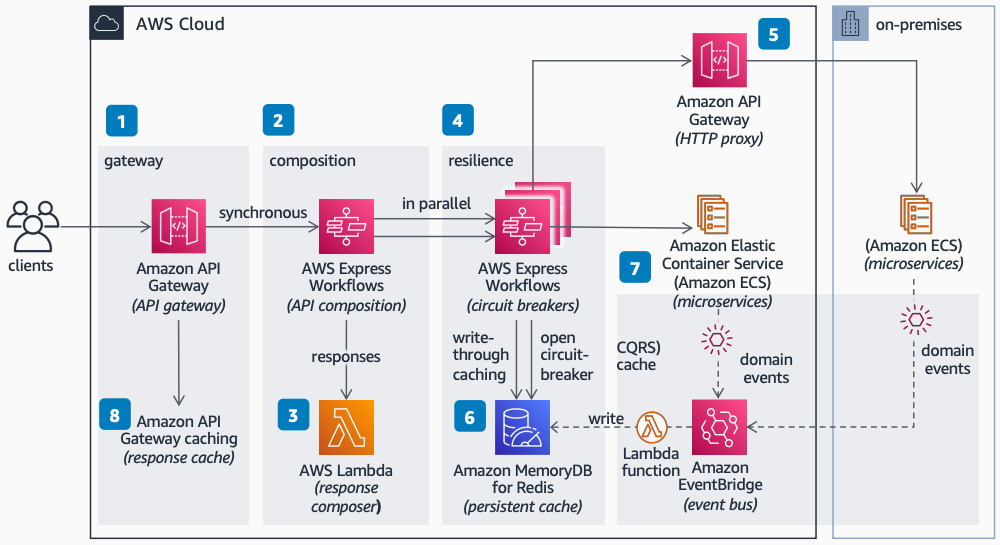
Los siguientes pasos describen la arquitectura:
-
Cree una puerta de enlace de API con Amazon API Gateway para permitir a los clientes enviar solicitudes web sincrónicas a sus microservicios.
-
Utilice Step Functions Express Workflows para crear un flujo de trabajo con pasos paralelos que invoquen varios microservicios al mismo tiempo.
-
Utilice una AWS Lambda función para componer las múltiples respuestas de los microservicios posteriores en una única respuesta agregada para los clientes.
-
Gestione las solicitudes paralelas con disyuntores diseñados con flujos de trabajo rápidos de Step Functions anidados y parametrizados para aumentar la resiliencia.
-
Utilice API Gateway para enviar por proxy las solicitudes HTTP al invocar microservicios locales.
-
Cree una base de datos de Amazon MemoryDB para Redis para almacenar en caché las respuestas de los microservicios mediante el patrón de almacenamiento en caché de escritura completa. https://docs.aws.amazon.com/whitepapers/latest/database-caching-strategies-using-redis/caching-patterns.html Cuando un microservicio descendente deja de estar disponible o su latencia alcanza un umbral, el circuito se cierra y lee todas las respuestas directamente desde la memoria caché.
-
Complemente los datos en caché con eventos de dominio de microservicios posteriores mediante el patrón CQRS. Cree un bus de eventos con Amazon y, a continuación EventBridge, gestione los eventos con una función Lambda para conservar los agregados de dominios en MemoryDB.
-
Habilite la caché de respuestas de API Gateway y ajuste los valores y filtros del tiempo de vida (TTL) en función de cada tipo de solicitud para aumentar el rendimiento.
Documentación adicional
Para obtener información adicional, consulte los siguientes recursos:
Historial del diagrama
Para recibir notificaciones sobre las actualizaciones de este diagrama de arquitectura de referencia, suscríbase a la fuente RSS.
| Cambio | Descripción | Fecha |
|---|---|---|
Publicación inicial | El diagrama de arquitectura de referencia se publicó por primera vez. | 17 de mayo de 2022 |
nota
Para suscribirse a las actualizaciones de RSS, debe tener un complemento de RSS habilitado para el navegador que esté utilizando.
